



Industry News
Text Size Test
Today’s challenging architectural projects demand powerful graphics cards. Whether you’re rendering high-resolution marketing images in V-Ray, generating real-time walkthroughs in Enscape, or collaborating on room-scale VR experiences in Unreal Engine, your GPU lies at the heart of your production pipeline. With the right workstation graphics card, architectural professionals can explore larger CAD and BIM data sets, iterate and validate designs more quickly, and deliver more content to their clients in less time.
Available worldwide through PNY Technologies, NVIDIA® Quadro RTX™ GPUs provide the power you need to tackle such complex tasks. For years, AEC professionals have turned to NVIDIA hardware for its combination of compute performance, graphics memory, and support for industry-standard software. Now, with their revolutionary Turing architecture and NVIDIA’s new dedicated RT ray tracing cores, the Quadro RTX series of cards – including the Quadro RTX 4000, 5000, 6000 and 8000 – are opening up new workflows in architectural design and visualization.
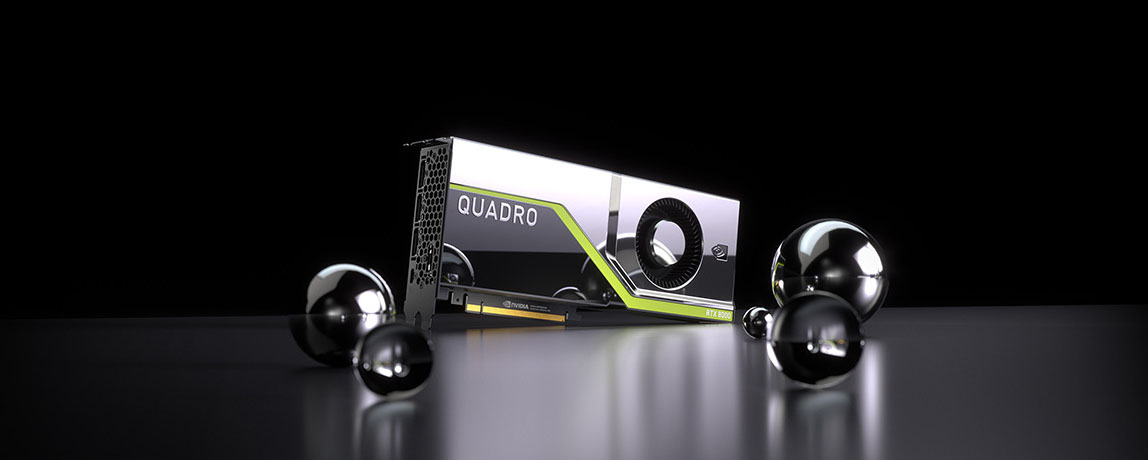
Key Quadro RTX benefits: shared GPU memory, AI acceleration and real-time ray tracing
The Turing architecture has several features that benefit graphically intensive tasks. One is the second generation of NVLink, NVIDIA’s high-speed GPU interconnection technology. With 48GB of error-correcting GDDR6 RAM, the Quadro RTX 8000 has more on-board graphics memory than any other commercially available workstation card. NVLink further enables users to split scene data across two GPUs, creating a potential pool of 96GB of shared memory: enough to fit even the largest architectural scene into the frame buffer during GPU rendering.
Turing cards also have three types of processor cores tailored to specific GPU computation tasks. CUDA cores, introduced in previous generations of NVIDIA hardware, accelerate general compute operations, and are now widely supported in GPU rendering applications, including many of the key third-party renderers for 3ds Max.
In addition, the Turing architecture’s Tensor cores are designed specifically for the tensor/matrix operations used in deep learning. In architectural pipelines, they accelerate AI-driven workflows like generative design and denoising: NVIDIA AI is integrated into key rendering applications, including V-Ray and Corona Renderer, enabling users to generate clean, noise-free images as they edit more quickly and efficiently than before.
The third type of processor core is transformative. The Quadro RTX cards’ new RT cores accelerate ray tracing, enabling a single GPU to render images with physically accurate shadows, reflections and refractions in real time. On the most challenging jobs, they provide an extra performance boost, right when you need it most.
You must be logged in to post a comment. Login here.



testing